
In courtrooms across the globe, a new legal frontier is emerging, one that seeks to hold governments, fossil fuel companies, and corporations accountable for their role in the climate crisis. Known as climate litigation, this powerful tool is no longer just about symbolic statements. It is fast becoming a legitimate means of securing climate justice.
As science sharpens its ability to trace emissions to specific actors, and as legal frameworks evolve to reflect environmental rights, climate litigation is rising. It is not an act of defiance, but a form of demanded accountability.
What Is Climate Litigation?
Climate litigation refers to the use of legal systems to address the causes and impacts of climate change. Cases typically fall into one or more of the following categories:
- Forcing stronger climate action from governments or corporations
- Seeking compensation for climate-related damage
- Challenging permits or policies that enable emissions-intensive projects
- Upholding human rights affected by environmental degradation
From lawsuits filed by youth activists to indigenous communities and city governments, the legal landscape is increasingly being used as a climate battleground.
Why It’s Gaining Momentum
There are three primary reasons behind the global rise in climate litigation:
Scientific Attribution
Breakthroughs in climate science have enabled researchers to attribute specific emissions, and related damages, to particular companies and industries. This means polluters can now be held directly responsible in court.
Public Pressure
As public awareness and climate activism grow, legal systems are being pushed to respond. Youth movements, NGOs, and citizen groups are increasingly turning to courts when policy action lags.
Judicial Precedents
Successful lawsuits, such as the Urgenda case in the Netherlands or the Shell climate ruling, have paved the way for similar legal arguments elsewhere. These victories have turned climate litigation into a credible strategy, not just an idealistic pursuit.
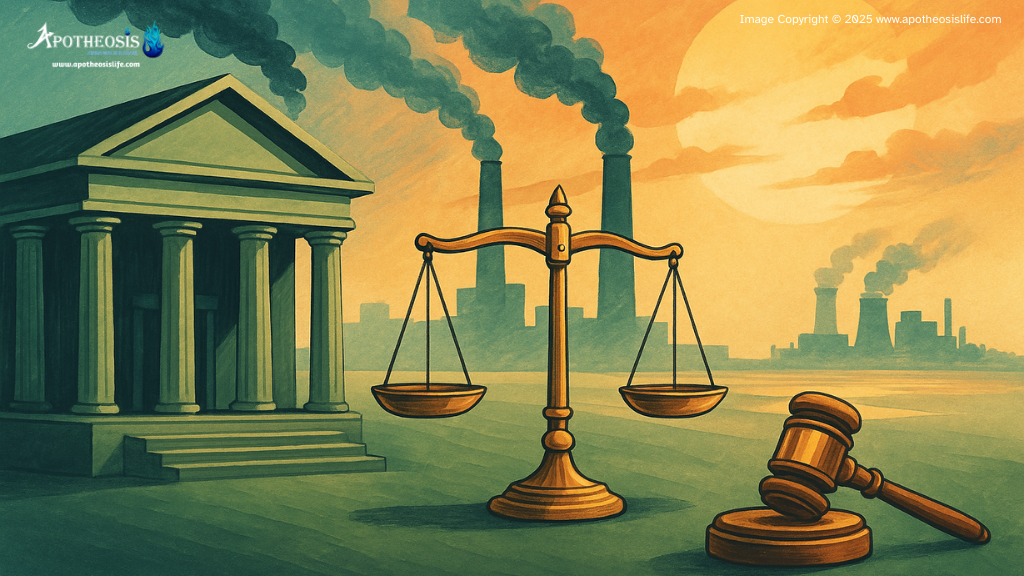
Image Copyright © 2025 www.apotheosislife.com
Landmark Cases Reshaping Climate Accountability
Several high-profile lawsuits have set critical precedents:
- Urgenda Foundation v. Netherlands (2019): The Dutch Supreme Court ruled that the government must reduce greenhouse gas emissions to protect its citizens, marking the first time a court ordered a nation to take climate action based on human rights obligations.
- Milieudefensie v. Shell (2021): A Dutch court ordered oil giant Shell to cut its global carbon emissions by 45% by 2030. This was the first time a private corporation was legally bound to align with the Paris Agreement.
- Juliana v. United States (Ongoing): Filed by 21 youth plaintiffs, this case argues that the U.S. government’s support for fossil fuels violates their constitutional rights to life, liberty, and property.
Challenges and Limitations
While climate litigation is gaining traction, it faces considerable challenges:
- Legal complexity: Proving direct causation between emissions and specific harms remains difficult in many jurisdictions
- Corporate defenses: Well-funded corporations often rely on long appeals and legal technicalities
- Policy resistance: Some governments push back against courts interfering in what they see as political decisions
Yet, despite these hurdles, the momentum is building. Courts are increasingly recognizing the legitimacy of climate harm claims.
A Global Movement, Not Just a Western Phenomenon
Climate litigation is not limited to Europe and North America. Countries such as Pakistan, South Africa, Colombia, and the Philippines have seen landmark cases rooted in environmental justice and constitutional rights.
In many of these cases, the courts have sided with vulnerable communities, reinforcing that climate justice is a global human right, not a luxury of developed nations.
Why This Matters for the Future
Climate litigation does more than seek compensation. It drives change. It:
- Forces transparency in emissions reporting
- Pressures companies to alter business models
- Challenges weak climate policies
- Empowers communities and amplifies voices typically left out of climate negotiations
Most importantly, it serves as a moral and legal check on the imbalance of power between polluters and the people most affected by climate change.
As climate impacts intensify, legal systems are becoming essential tools for driving accountability. Climate litigation isn’t just about punishment. It’s about protecting rights, enforcing promises, and creating real world consequences for climate negligence. We are entering an era where greenwashing will not suffice and where climate justice will be argued in court as much as it is debated in policy rooms. The message is clear: if governments and corporations will not act voluntarily, the law may force them to.
Details of the Featured Image
- Caption: A symbolic split scene showing industrial pollution on one side and legal justice on the other, reflecting the rise of climate litigation.
- Image Copyright © 2025 www.apotheosislife.com
Author
Ziara Lakshyā Akari
Copyright © 2025 www.apotheosislife.com